Determining the proper axle ratio for a vehicle is a critical decision that can significantly impact its performance, fuel efficiency, and overall driving experience. As an axle supplier, I’ve witnessed firsthand how a well – chosen axle ratio can transform a vehicle’s capabilities. In this blog, I’ll guide you through the process of calculating the appropriate axle ratio for your vehicle. Axle

Understanding Axle Ratio
Before delving into the calculations, it’s essential to understand what an axle ratio is. The axle ratio is the number of times the driveshaft must rotate to turn the wheels once. It is expressed as a ratio, such as 3.55:1. This means that for every 3.55 rotations of the driveshaft, the wheels make one full rotation.
A lower axle ratio (e.g., 2.73:1) provides better fuel efficiency and higher top – end speed because the engine doesn’t have to work as hard at highway speeds. On the other hand, a higher axle ratio (e.g., 4.10:1) offers more torque, which is beneficial for towing, hauling heavy loads, or quick acceleration from a stop.
Factors Affecting Axle Ratio Selection
-
Vehicle Usage:
- Daily Commuting: If your vehicle is primarily used for daily commuting on highways, a lower axle ratio is ideal. It allows the engine to run at lower RPMs, reducing fuel consumption and engine wear. For example, a sedan used for a 50 – mile round – trip commute on the highway would benefit from an axle ratio in the range of 2.73:1 to 3.23:1.
- Towing and Hauling: When towing a trailer or carrying heavy loads, a higher axle ratio is necessary. The additional torque provided by a higher ratio helps the vehicle handle the extra weight more easily. For a full – size pickup truck used for towing a 5,000 – pound trailer, an axle ratio of 3.73:1 or higher would be appropriate.
- Performance Driving: For those who enjoy high – performance driving, a higher axle ratio can provide quicker acceleration. Sports cars often have axle ratios in the range of 3.55:1 to 4.10:1 to maximize their acceleration capabilities.
-
Engine Power and Torque:
- A powerful engine with high torque can handle a higher axle ratio without straining. For instance, a V8 engine with a large displacement and significant torque output can effectively use a 4.10:1 or even a 4.56:1 axle ratio. In contrast, a smaller, less powerful engine may struggle with a high – ratio axle and would be better suited for a lower ratio.
-
Transmission Type:
- Manual Transmission: Manual transmissions give the driver more control over gear selection. A driver can compensate for a less – than – ideal axle ratio by manually shifting gears. However, a well – matched axle ratio still improves the overall driving experience.
- Automatic Transmission: Automatic transmissions rely on the axle ratio to optimize gear shifting. A proper axle ratio ensures smooth gear changes and efficient power delivery. For example, a modern automatic transmission may work best with an axle ratio that allows it to stay in the optimal power band for as long as possible.
Calculating the Axle Ratio
There are several methods to calculate the appropriate axle ratio for a vehicle. Here are two common approaches:
Method 1: Using Tire Size and Desired RPM
- Determine Tire Circumference:
- First, measure the diameter of your tire. You can find this information on the sidewall of the tire. For example, if your tire size is P225/60R16, the diameter can be calculated using the formula:
[D = 2\times\frac{225\times0.6}{25.4}+ 16] - Calculate the tire circumference (C=\pi\times D). For a tire with a diameter of 26 inches, the circumference (C=\pi\times26\approx81.68) inches.
- First, measure the diameter of your tire. You can find this information on the sidewall of the tire. For example, if your tire size is P225/60R16, the diameter can be calculated using the formula:
- Decide on Desired RPM at a Given Speed:
- Let’s say you want your engine to run at 2000 RPM when driving at 60 mph.
- Calculate the Axle Ratio:
- First, convert the speed from mph to inches per minute. Since 1 mile = 5280 feet and 1 foot = 12 inches, 60 mph is (60\times5280\times12\div60 = 63360) inches per minute.
- The number of tire rotations per minute (n=\frac{63360}{C}). Using the tire circumference of 81.68 inches, (n=\frac{63360}{81.68}\approx776) rotations per minute.
- The axle ratio (AR=\frac{RPM}{n}). With an RPM of 2000 and (n = 776), the axle ratio (AR=\frac{2000}{776}\approx2.58).
Method 2: Using Gear Ratios and Final Drive Ratio
- Understand Gear Ratios:
- If you know the gear ratios of your transmission and the desired performance characteristics, you can calculate the axle ratio. For example, if your transmission has a 1:1 top – gear ratio and you want to achieve a certain speed and RPM combination.
- Let’s assume the vehicle’s speed is (v) (in mph), the tire circumference is (C) (in inches), and the desired engine RPM is (R).
- The speed in inches per minute (S = v\times5280\times12\div60). The number of tire rotations per minute (T=\frac{S}{C}).
- If the transmission gear ratio in the current gear is (GR), the axle ratio (AR=\frac{R}{T\times GR}).
Fine – Tuning the Axle Ratio
Once you’ve calculated the approximate axle ratio, it’s important to fine – tune it based on real – world driving conditions and personal preferences. You may need to make adjustments for factors such as road conditions, elevation changes, and the weight of passengers and cargo.
For example, if you frequently drive in mountainous areas, you may want to increase the axle ratio slightly to ensure better performance when climbing steep grades. Similarly, if you live in an area with a lot of stop – and – go traffic, a higher axle ratio can provide quicker acceleration from a stop.
The Role of an Axle Supplier
As an axle supplier, we play a crucial role in helping you select the right axle ratio for your vehicle. We have in – depth knowledge of different axle ratios and their performance characteristics. Our team of experts can analyze your vehicle’s specifications, usage patterns, and performance goals to recommend the most suitable axle ratio.
We also offer a wide range of axles with different ratios to meet your specific needs. Whether you’re looking for an axle for a daily commuter, a heavy – duty work truck, or a high – performance sports car, we have the products to match.
Conclusion
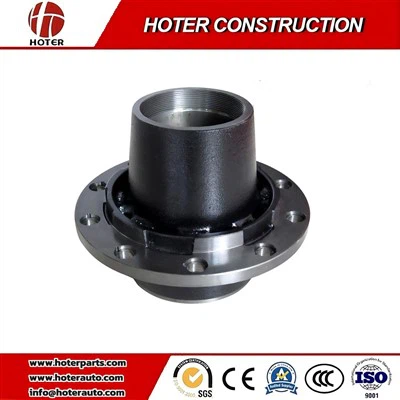
Calculating the proper axle ratio for a vehicle is a complex but essential process. By understanding the factors that affect axle ratio selection and using the appropriate calculation methods, you can optimize your vehicle’s performance, fuel efficiency, and driving experience.
Leaf Spring If you’re in the market for a new axle or need advice on selecting the right axle ratio for your vehicle, don’t hesitate to reach out. Our team of experts is ready to assist you in making the best decision for your needs. Contact us today to start the conversation about your axle requirements.
References
- "Automotive Chassis Engineering" by Thomas D. Gillespie
- "Fundamentals of Vehicle Dynamics" by Thomas D. Gillespie
- Various automotive technical manuals and industry publications
Zhangzhou Hoter Construction Machinery and Parts Co., Ltd.
As one of the most professional axle manufacturers and suppliers in China, we’re featured by quality products and good price. Please rest assured to wholesale high-grade axle for sale here from our factory. Contact us for more details.
Address: No. 3/4-41, Ziwei Road, Longhai, Zhangzhou city, Fujian province, China
E-mail: info@hoterparts.com
WebSite: https://www.hoterparts.com/
