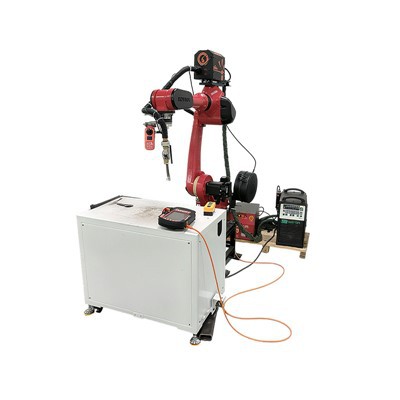
Welding is a crucial process in numerous industries, from automotive manufacturing and aerospace engineering to construction and shipbuilding. With the advancement of technology, welding robots have become a game – changer, significantly improving the efficiency, quality, and safety of the welding process. As a welding robot supplier, I often encounter the question: “How fast can a welding robot weld?” In this blog, I will delve into this topic, taking you through various factors affecting a welding robot’s speed and the typical speeds you can expect in different scenarios. Welding Robot
Factors Affecting the Welding Speed of a Robot
1. Welding Method
There are several welding methods, including Gas Metal Arc Welding (GMAW), Gas Tungsten Arc Welding (GTAW), and Shielded Metal Arc Welding (SMAW). Each method has its own set of characteristics that determine the achievable welding speed.
GMAW, also known as MIG (Metal – Inert Gas) welding, is one of the fastest welding methods. It uses a continuous solid wire electrode fed through a welding gun, along with a shielding gas to protect the weld pool from atmospheric contamination. Since the wire is continuously fed, GMAW allows for a high deposition rate, which means more filler material can be added to the weld joint per unit of time. In some industrial applications, GMAW welding robots can achieve travel speeds of up to 100 inches per minute (254 cm/min).
GTAW, or TIG (Tungsten – Inert Gas) welding, on the other hand, is generally slower. It uses a non – consumable tungsten electrode to create the weld arc. The filler material is added manually or automatically, but the process is more precise and requires more control. GTAW is often used for high – quality, thin – walled applications where aesthetics and precision are crucial. Travel speeds for GTAW welding robots typically range from 5 to 20 inches per minute (12.7 to 50.8 cm/min).
SMAW, or stick welding, involves using a consumable electrode covered in flux. It is a versatile but relatively slower welding method. The process requires the welder (or the welding robot) to change electrodes periodically, which interrupts the welding process. Travel speeds for SMAW welding robots are usually in the range of 3 to 10 inches per minute (7.62 to 25.4 cm/min).
2. Material Thickness and Type
The thickness and type of the material being welded have a significant impact on the welding speed. Thicker materials require more heat input and more filler material to create a proper weld joint. As a result, the welding speed decreases as the material thickness increases.
For example, when welding thin sheets of aluminum (less than 1/8 inch or 3.175 mm thick) using GMAW, a welding robot can achieve relatively high travel speeds, perhaps 60 to 80 inches per minute (152.4 to 203.2 cm/min). However, when welding thick steel plates (over 1 inch or 25.4 mm thick), the speed may drop to 10 to 30 inches per minute (25.4 to 76.2 cm/min).
Different materials also have different thermal conductivity and melting points. Materials with high thermal conductivity, such as copper and aluminum, dissipate heat quickly, which may require slower welding speeds to ensure proper fusion. Materials with high melting points, like some alloys used in aerospace applications, also need more heat input and, therefore, slower welding speeds.
3. Weld Joint Complexity
The complexity of the weld joint affects the welding speed. Simple straight – line welds are the easiest and fastest to perform. A welding robot can move smoothly along a straight path, maintaining a consistent travel speed.
However, when dealing with complex geometries, such as curved or irregularly shaped weld joints, the robot needs to slow down to ensure accurate positioning and consistent weld quality. For example, welding a circular seam requires the robot to continuously adjust its position and orientation, which may reduce the travel speed compared to a straight – line weld.
In addition, multi – pass welds, where multiple layers of filler material are added to the weld joint, take more time. Each pass needs to be carefully applied, and the robot may need to wait for the weld to cool between passes to prevent overheating and distortion.
4. Robot’s Technical Specifications
The technical specifications of the welding robot itself play a crucial role in determining its welding speed. The robot’s maximum speed of movement, acceleration, and deceleration capabilities are important factors.
A high – end welding robot with a fast maximum speed and good acceleration can move quickly from one welding point to another, reducing the idle time between welds. For example, some advanced robotics can reach maximum linear speeds of up to 3 meters per second.
The accuracy of the robot’s motion control is also essential. A robot with high – precision motion control can maintain a consistent travel speed and weld bead geometry, which is crucial for high – quality welding. Additionally, the robot’s payload capacity can affect its speed. If the robot is carrying a heavy welding gun or other equipment, it may need to move more slowly to ensure stability.
Typical Welding Speeds in Different Industries
1. Automotive Industry
In the automotive industry, welding robots are used extensively for joining various components, such as body panels, frames, and engine parts. The high – volume production nature of the automotive industry demands fast welding speeds.
For GMAW welding of automotive body panels, which are typically made of thin steel or aluminum sheets, welding robots can achieve travel speeds of 30 to 60 inches per minute (76.2 to 152.4 cm/min). The robots are often programmed to perform multiple welds in a short time, and the high – speed operation helps to increase the overall production efficiency.
2. Aerospace Industry
The aerospace industry has strict quality and safety requirements for welded components. The materials used, such as titanium alloys and high – strength steels, often require precise welding processes with slower speeds.
GTAW is commonly used in aerospace applications due to its high – quality welds. Welding robots in this industry may operate at travel speeds of 5 to 15 inches per minute (12.7 to 38.1 cm/min) for critical components, such as aircraft wings and engine parts.
3. Construction Industry
In the construction industry, welding robots are used for fabricating steel structures, such as bridges and building frames. The materials are usually thick steel sections, and the welding requirements focus on strength and durability.
SMAW and GMAW are the common welding methods. Welding robots for construction applications may have travel speeds ranging from 5 to 20 inches per minute (12.7 to 50.8 cm/min), depending on the thickness of the steel and the type of weld joint.
Advantages of Fast – Welding Robots
Fast – welding robots offer several advantages to manufacturers. Firstly, they significantly increase production efficiency. By reducing the time required for each weld, more products can be manufactured in a shorter period. This is especially important in high – volume production environments, where even a small increase in welding speed can lead to a substantial increase in output.
Secondly, fast – welding robots can improve quality control. Since the welding process is automated, there is less variability in the welds compared to manual welding. Robots can maintain a consistent travel speed, welding current, and other parameters, resulting in more uniform and high – quality welds.
Finally, fast – welding robots enhance worker safety. Welding is a hazardous process that involves exposure to high temperatures, radiation, and fumes. By automating the welding process, workers can be removed from the immediate danger zone, reducing the risk of accidents and occupational diseases.
Contact for Purchase and Negotiation
Palletizing/Depalletizing Robot If you are looking to enhance your manufacturing process with high – speed welding robots, I’m here to help. As a professional welding robot supplier, we have a wide range of products that can meet your specific needs, whether you require high – speed GMAW robots for automotive production or precise GTAW robots for aerospace applications. Our team of experts can provide you with detailed information, conduct on – site demonstrations, and offer customized solutions. Contact us to start the purchase negotiation process, and let’s work together to improve your welding efficiency and product quality.
References
- Metals Handbook: Welding, Brazing, and Soldering, ASM International
- Welding Technology Handbook, Joseph A. Yaghi
- Robotics in Manufacturing: A Practical Guide, Peter Kopacek
Dongguan Chuanglida Intelligent Equipments Co., Ltd.
As one of the most professional welding robot manufacturers and suppliers in China, we also support customized service. Please feel free to buy discount welding robot in stock here from our factory. For price consultation, contact us.
Address: Room 201, Building 2, No. 61, Shachang 1st Road, Dalang Town, Dongguan City, Guangdong Province
E-mail: haoguangli001@outlook.com
WebSite: https://www.boruntestech.com/
